Arc Mainnet Explained
Circle is bringing Arc Mainnet to the public on September 16, 2026, introducing a Layer-1 blockchain built specifically around stablecoins, payments, foreign exchange, tokenized assets and the emerging agentic economy. Unlike general-purpose blockchains that try to support almost every type of application, Arc has a much narrower focus: financial infrastructure for the internet. The network is designed around USDC, with dollar-denominated transaction fees, fast deterministic finality, EVM compatibility, built-in foreign exchange infrastructure and optional privacy features.

In this guide, we cover everything you need to know about Arc Mainnet, its history, technology, key features, ecosystem, institutions, DeFi and NFT projects, potential use cases.
1. What Is Arc Mainnet?
What Is Arc?
Arc is an EVM-compatible Layer-1 blockchain developed by Circle for stablecoin-native financial applications.
Its primary focus areas include:
1. Stablecoin payments
2. Cross-border payments
3. Foreign exchange
4. DeFi
5. Lending and credit
6. Tokenized real-world assets
7. Institutional finance
8. Wallets and custody
9. AI and agentic payments
One of Arc's biggest differences is its approach to transaction fees. Instead of requiring users and applications to hold a volatile native asset to pay gas, Arc is designed around USDC-denominated transaction fees. That makes the cost of using the network easier to understand for businesses, financial institutions and applications built around dollar-based transactions.
Who Built Arc?
Arc is developed by Circle, the company behind USDC. Circle's existing stablecoin infrastructure gives Arc an important advantage: it does not have to build a stablecoin ecosystem from scratch. The company is attempting to connect USDC liquidity, institutional finance, payments and blockchain infrastructure through a dedicated Layer-1.
Why Did Circle Build Arc?
Circle's argument is that existing blockchains were not specifically designed for the requirements of modern financial infrastructure.
Businesses dealing with payments and capital markets often need:
1. Predictable transaction costs
2. Fast settlement
3. Deep stablecoin liquidity
4. Cross-border functionality
5. Compliance-friendly infrastructure
6. Privacy options
7. Institutional-grade reliability
Arc is designed around these requirements.
Circle describes Arc as an economic operating system for the internet. The idea is relatively simple: If digital dollars become a major part of global commerce, the infrastructure moving those dollars needs to be fast, programmable, interoperable and reliable. Arc is Circle's attempt to build that infrastructure at the blockchain layer.
Who Is Arc Built For?
Arc is primarily aimed at developers and businesses building:
1. Payment applications
2. Stablecoin products
3. DeFi protocols
4. Lending markets
5. Exchanges
6. FX platforms
7. Tokenized assets
8. Institutional financial products
9. Wallets and custody solutions
10. AI-agent payment systems
2. Arc's Journey
Arc has moved from idea to public mainnet in a little over a year, a genuinely fast timeline by Layer-1 standards.
2025
1. August 2025: Circle publicly unveils Arc as an open Layer-1 for stablecoin finance.
2. Late 2025: Private development ramps up as early ecosystem partners begin onboarding.
3. October 2025: Arc's public testnet goes live, quickly pulling in 100+ launch and design partners.
2026
1. May 2026: Circle releases the ARC token whitepaper/framework and reportedly raises $222 million in a token presale, valuing the network at roughly $3 billion. The ARC token itself has not launched.
2. Mid-2026: Institutional partnerships expand rapidly during a private mainnet phase; the testnet crosses hundreds of millions of processed transactions and grows to 100+ active builders.
3. August 5, 2026: Circle names its 11-member founding validator cohort (BlackRock, DTCC, Visa, Mastercard, Fireblocks, and more) alongside major ecosystem integrations.
4. September 16, 2026: Arc public mainnet officially launches, opening the network to anyone building on it.
3. Why Did Circle Build Arc?
The simplest way to understand Arc is to understand the problems Circle wants to solve.
1. Volatile Gas Fees
For businesses processing payments, unpredictable blockchain fees can make financial planning difficult. Arc uses USDC-denominated fees, making transaction costs easier to understand in dollar terms.
2. Stablecoin Fragmentation
Stablecoins exist across multiple blockchains, creating fragmented liquidity and additional complexity for users and developers. Arc is designed to make stablecoin activity a first-class function of the network.
3. Cross-Border Payments
Traditional cross-border payments can involve multiple intermediaries, currencies and settlement systems. Arc's combination of stablecoins, fast settlement and FX infrastructure is designed to simplify this process.
4. Institutional Requirements
Financial institutions need more than speed.
They also care about:
1. Compliance
2. Auditability
3. Operational reliability
4. Privacy
5. Custody
6. Settlement certainty
Arc is being designed with these requirements in mind.
7. Tokenized Assets
As financial assets move on-chain, blockchain infrastructure needs to support more than simple token transfers. Arc is targeting tokenized funds, credit, Treasuries, commodities and other real-world assets.
8. AI and Agentic Commerce
AI agents could eventually transact independently. That creates a new requirement: programmable money that software can hold, move and spend. Arc sees this as another potential use case for its infrastructure.
4. How Does Arc Work?
You do not need to be a blockchain developer to understand Arc's basic architecture. At a high level, Arc is a standalone Layer-1 with an Ethereum-compatible execution environment and a consensus system designed for fast deterministic finality.
Arc Architecture:
1. Layer-1: Arc operates as its own blockchain rather than an Ethereum Layer-2.
2. EVM-Compatible: Developers can use Solidity and familiar Ethereum development tools to build applications on Arc.
3. Execution: Arc uses an Ethereum-compatible execution environment, making it easier for existing EVM developers and applications to migrate.
4. Consensus: Arc uses Malachite, a Byzantine Fault Tolerant consensus engine derived from Tendermint-style architecture. The goal is deterministic finality in under one second.
5. USDC Gas: Transaction fees are denominated in USDC rather than a volatile native gas token.
6. Validators: Arc launches with a group of institutional and ecosystem validators, with Circle playing a central role in the network.
A Simple Arc Transaction
The process can be simplified as:
User → Wallet → Arc → Smart Contract → Consensus → Final Settlement → Application
For users, most of this happens behind the scenes. The important part is that applications can settle transactions quickly while using dollar-denominated fees.
5. Arc's Key Features, Explained
1. USDC-based gas fees
Fees are priced and paid in dollars via USDC, stripping out the volatility of a native gas token. For payments and treasury operations, this is a genuine game-changer- no more guessing what a transaction will cost tomorrow.
2. Sub-second finality
Thanks to Malachite, Arc settles transactions deterministically in under a second: fast enough for point-of-sale-style UX, real-time FX conversion, and broker-grade settlement flows.
3. Stablecoin-native infrastructure
Unlike general-purpose chains bolting on payments features after the fact, Arc was designed around stablecoin payments, lending, trading, and tokenized assets from day one.
4. Built-in FX infrastructure
StableFX, Arc's native on-chain FX engine, enables real-time swaps between stablecoins denominated in different currencies, a feature most chains simply don't have natively.
5. Opt-in privacy
Privacy runs through EVM precompiles with pluggable cryptographic backends, plus audit-disclosure channels so institutions can stay private from competitors while remaining compliant with regulators.
6. Full EVM compatibility
Developers can deploy existing Solidity contracts and keep using familiar tools like Hardhat and Foundry, no need to learn a new language or toolchain.
7. Cross-chain interoperability
Multiple bridge and messaging providers are part of the day-one ecosystem, so assets and data can move between Arc and other major chains.
8. Institutional-grade security
Founding validators span asset managers, clearing houses, card networks, and global banks, meaning the institutions securing the network are often the same ones expected to build on it.
9. Tokenized real-world assets
Arc is explicitly positioned for tokenized funds, credit, Treasuries, commodities, and other real-world assets, not just crypto-native tokens.
10. Built for agentic finance
Circle has been explicit that AI agents holding and moving programmable money is a core design goal, not an afterthought.
6. Arc vs Ethereum, Solana and Base
Arc is not necessarily trying to replace every existing Layer-1.
Its strategy is different.
|
Feature |
Arc |
Ethereum |
Solana |
Base |
|
Network type |
L1 |
L1 |
L1 |
Ethereum L2 |
|
Primary focus |
Stablecoin & financial infrastructure |
General-purpose |
High-performance applications |
Ethereum scaling |
|
Gas asset |
USDC-focused |
ETH |
SOL |
ETH |
|
EVM |
Yes |
Yes |
No, SVM |
Yes |
|
Finality |
Designed for sub |
Longer settlement model |
Very fast |
Inherits Ethereum security |
|
Payments |
Core use case |
Broad |
Growing |
Growing |
|
FX |
Core design |
Application layer |
Application layer |
Application layer |
|
Institutional focus |
Core positioning |
High |
Growing |
High |
The important distinction is not that Arc is automatically "better." It is that Arc is being optimized for a different job. Ethereum is the dominant general-purpose smart contract platform. Solana is focused heavily on high-performance applications. Base is an Ethereum scaling network with strong consumer and exchange distribution. Arc is positioning itself around stablecoins and financial settlement.
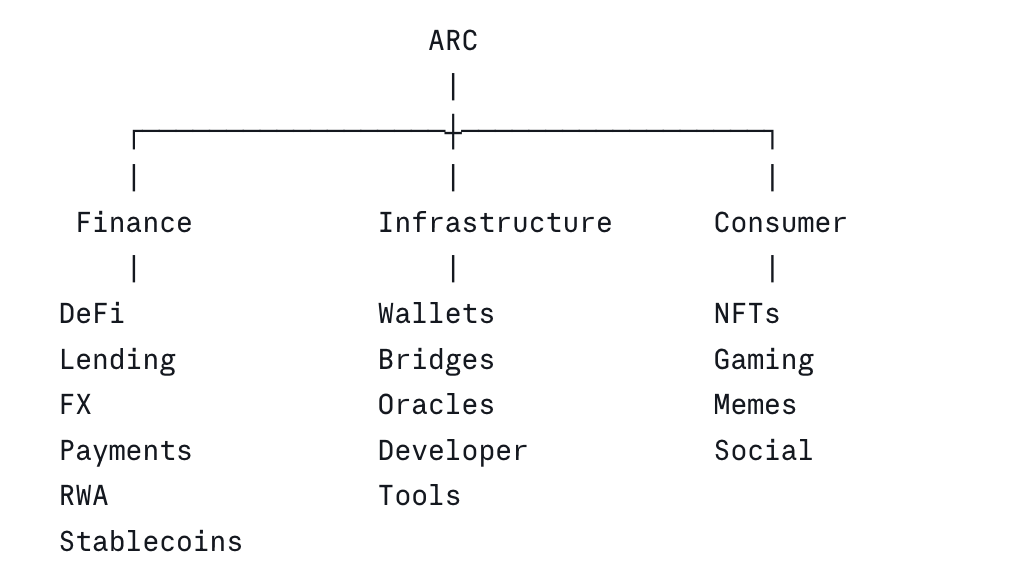
7. Arc Ecosystem?
Circle reports more than 100 ecosystem and institutional builders already active on Arc's private mainnet ahead of public launch. Independent community trackers put the broader project count even higher, around 178 projects spanning payments, banking, stablecoins, RWAs, exchanges, DeFi, wallets, bridges, infrastructure, compliance tooling, and launchpads.

What's showing up across categories:
1. Payments & payment infrastructure: Rain, Thunes, and Wirex, focused on card-based and cross-border settlement.
2. Stablecoins & FX: USDC-native issuance plus multi-currency rails through StableFX.
3. DeFi: Aave, Morpho, Uniswap, and Aerodrome, alongside aggregators and market makers like FalconX, Galaxy, GSR, and Keyrock.
4. Lending & credit: Both institutional and retail lending markets built around USDC collateral.
5. Exchanges & derivatives: On-chain orderbooks and AMMs, including edgeX's plans for 24/7 FX perpetuals (starting with USD/JPY) across 150+ markets.
6. Tokenized RWAs: BlackRock's BUIDL fund is planned for deployment on Arc, with DTCC targeting deeper tokenization work in 2027.
7. Wallets & custody: Day-one integrations expected from Binance Wallet, Kraken, Ledger, MetaMask, Fireblocks, and Upbit.
8. Bridges & cross-chain infra: Multiple providers in the launch lineup.
9. Developer tooling: RPC providers, indexers, oracles, and EVM developer infrastructure.
10. AI and agentic finance: Agent wallets, automated vendor payments, and machine-to-machine commerce prototypes.
11. NFTs & consumer apps: An emerging wave of collections and consumer products already testing on testnet and private mainnet.
12. Launchpads: Platforms like Synthra (an AMM, aggregator, and launchpad rolled into one).
13. Community & meme projects: Active meme trading and community activity building ahead of mainnet.
A quick visual snapshot
Who's Backing Arc?
1. Founding validators (alongside Circle): BlackRock, DTCC, Fireblocks, Galaxy, Global Payments, ICE, Mastercard, MoneyGram, SBI Group, Standard Chartered, Sumitomo Corporation, and Visa.
2. DeFi protocols & capital allocators: Aave, Aerodrome, FalconX, Fireblocks, GSR, Kraken, Morpho, Nonco, Uniswap, and XFX.
3. Stablecoin payment providers: Rain, Tempo, and Wirex.
4. Exchanges & wallet providers: Binance, Coinbase, Ledger, MetaMask, Fireblocks, MoonPay, Uniswap, and Upbit.
8. Projects Catching Our Attention on Arc
With Arc Mainnet entering its public launch phase, a growing number of projects are building around trading, DeFi, payments, institutional finance, NFTs and tokenized assets. The projects below cover different parts of the ecosystem, so they should not be viewed as direct competitors. Some are focused on liquidity and trading, while others are targeting institutional markets, token launches or consumer applications.
Fomo
Fomo is building a mobile-first, cross-chain crypto trading platform designed to make buying memecoins, altcoins and other tokens simpler. The idea is straightforward: users should not have to manually think about which blockchain they are using, where liquidity is located, how to bridge their assets or which token they need for gas.
Fomo aims to abstract much of that complexity behind a single trading experience. If Arc develops a broad multi-chain trading ecosystem, applications like Fomo could help make that infrastructure easier for retail users to access.
AKA (akadotfun)
AKA, also known as akadotfun, is taking a different approach to the traditional memecoin launchpad model. Instead of relying on a conventional bonding curve, AKA's current design involves launching tokens directly into Uniswap liquidity, while Uniswap v4 hooks are used to distribute trading fees across creators, holders, referrals, community rewards and an RWA treasury.
The RWA component is what makes AKA particularly interesting. Under the project's current design, a portion of trading fees can potentially be directed toward tokenized real-world assets such as stocks or Treasuries. This creates an unusual connection between two very different crypto narratives: memecoin activity and tokenized traditional financial assets.
UnitFlowFinance
UnitFlowFinance is attempting to build a broader DeFi infrastructure stack rather than focusing on a single application.
Its ecosystem combines:
1. V2.5, V3 and V4 AMMs
2. Liquidity management
3. A no-code token factory
4. Analytics
5. AI-assisted execution
6. Cross-chain USDC transfers through Circle CCTP
The broader goal is to provide some of the basic liquidity infrastructure a new ecosystem needs from day one. This could become increasingly relevant as more tokens and applications launch on Arc and liquidity becomes distributed across multiple venues.
TowerExchange
As more decentralized exchanges launch on Arc, liquidity fragmentation could become an important problem. TowerExchange is approaching that issue from the aggregation side.
The protocol is designed to scan liquidity across Arc-based DEXs and route swaps based on factors such as:
1. Liquidity depth
2. Slippage
3. Transaction costs
4. Available execution routes
Its developer stack also focuses on routing, cross-chain transfers and transaction execution through APIs. The concept is relatively simple: UnitFlowFinance and other protocols can help create liquidity, while TowerExchange is trying to make that liquidity easier to access.
Hibachi
Hibachi is one of the projects that closely matches Arc's institutional financial-market thesis. The project is building an FX spot and perpetuals venue that combines an off-chain central limit order book for fast execution with zero-knowledge proofs for post-trade settlement on Arc. Hibachi is also part of the Arc Builders Fund, with Circle Ventures disclosed as an investor.
Hibachi plans to start with FX perpetuals before expanding into spot FX. Its target market is different from a typical retail DEX. The platform is designed around the needs of professional traders who require:
1. Low-latency execution
2. Predictable costs
3. Settlement certainty
4. Financial-market infrastructure
Synthra Finance
Synthra Finance is building a chain-abstracted trading layer that combines spot trading, liquidity and perpetuals into a unified interface. Instead of forcing users to think about individual chains, protocols and liquidity venues, Synthra aims to give users something closer to one trading account and one balance.
Its routing infrastructure determines where execution actually takes place. The platform combines non-custodial, on-chain settlement with multiple sources of liquidity. Perpetual markets are integrated through Hyperliquid, while spot liquidity is handled through Synthra's own infrastructure and external execution routes. This approach could become increasingly useful as multi-chain liquidity becomes more fragmented.
Sidoor
While Hibachi is focused on professional and institutional markets, Sidoor is taking a more retail-focused approach. The platform combines several functions within a single interface, including:
1. Token discovery
2. Trending markets
3. Portfolio tracking
4. Bridging
5. Launchpad functionality
6. Sniper tools
The goal is to reduce the number of steps between discovering a token, moving capital and executing a trade. This could be particularly useful in an emerging ecosystem like Arc, where new tokens and applications may appear quickly. Instead of forcing users to move between multiple websites and applications, Sidoor is attempting to bring discovery, portfolio management and execution into a single workflow.
edgeX
edgeX is another project worth watching within Arc's emerging trading ecosystem. Its focus on 24/7 markets and derivatives infrastructure could fit with Arc's broader ambition to support financial markets that operate continuously on stablecoin-based rails.
The potential use case extends beyond conventional crypto trading. Around-the-clock infrastructure could eventually support products such as FX and other financial instruments that traditionally operate within more restricted market hours. However, projects operating in derivatives and financial markets face additional challenges around liquidity, regulation, risk management and oracle infrastructure.
For Arc, edgeX is interesting because it represents the possibility of connecting blockchain-native trading with a broader financial-market infrastructure.
AchSwap
AchSwap is focused on the decentralized exchange and aggregation side of the Arc ecosystem. Rather than being another application built purely around token speculation, its relevance comes from the basic infrastructure required for a functioning DeFi market.
A new blockchain needs places where users can:
1. Swap assets
2. Discover liquidity
3. Provide liquidity
4. Move between trading pairs
5. Access different financial applications
AchSwap is therefore part of the broader race to establish Arc's early trading layer.
BUIDL
BUIDL is different from the other projects on this list because its importance comes from the institutional RWA narrative rather than retail trading. BlackRock's tokenized fund has become one of the better-known examples of traditional financial assets being represented on blockchain infrastructure. Its presence within the broader Arc ecosystem is relevant because tokenized funds and other real-world assets are central to the type of financial activity Arc is designed to support.
Shadow Ronin
Shadow Ronin represents a completely different side of the Arc ecosystem: NFTs and consumer-focused applications. It is among the early NFT projects attracting attention around the Arc launch, with the collection discussed as a 3,500-piece project targeting the Mainnet launch period. NFTs may not be the primary reason Arc was created, but they can still play an important role in testing whether the network attracts consumer applications beyond financial infrastructure. The main factors to watch are community size, actual mint activity, secondary-market liquidity and long-term demand.
ACTFUN
ACTFUN is another project to watch within Arc's emerging launchpad and discovery ecosystem. Launchpads can play an important role in new blockchain ecosystems by giving early projects a place to launch, while also giving users a way to discover new applications and tokens. That makes this category particularly relevant to Arc.
If the number of Arc-native projects grows rapidly, discovery itself could become a problem. Users will need better ways to identify projects, compare opportunities and find new launches. ACTFUN is therefore interesting from an ecosystem-discovery perspective.
9. Arc NFT Ecosystem
NFTs are likely to form a smaller but more experimental part of the early Arc ecosystem. Community discussions have already highlighted several collections that are preparing for or exploring Arc, including:
1. AKA
2. Arcins
3. Arclings
4. Arc Angelz
5. Arc Kitties
6. Arc Mfers
7. Arc Penguins
8. Arc Punks
9. Arcadians
10. ArchAngels
11. ARChitects
12. Art Rebels Club
13. Broke Bookies
14. Chipis
15. HIZUMI
16. Owl Arc
17. Shadow Ronin
18. Sharc
19. ArcCitizens
20. ArcTerminalss
Some community-listed collections have advertised free or low-cost mints, with proposed supplies ranging from a few thousand to roughly 10,000 NFTs. Shadow Ronin, for example, has been discussed as a 3,500-piece collection targeting the Arc Mainnet launch period.
However, this part of the ecosystem needs extra caution. Many NFT projects are community-led, newly announced or still in development. Their appearance on social media or an ecosystem list should not be interpreted as Circle endorsement or proof that a collection is legitimate.
Before minting, users should verify:
1. The project's official account.
2. The official mint website.
3. The contract address.
4. Whether the contract is actually deployed on Arc.
5. Mint price and supply.
6. Whether the collection has publicly documented founders or team members.
7. Whether the mint transaction is interacting with the expected contract.
For an early ecosystem, this verification step is particularly important because the period around a new mainnet launch can attract impersonators and speculative projects.
10. Arc and DeFi
DeFi could become one of Arc's most important ecosystem sectors. Protocols such as Aave, Morpho, Uniswap and Aerodrome could help create initial liquidity and user activity if their Arc deployments develop as planned.
Potential applications include:
1. USDC lending
2. Stablecoin borrowing
3. Decentralized exchanges
4. Liquidity aggregation
5. Stablecoin yield strategies
6. Institutional lending
7. RWA-backed credit
8. Treasury management
9. Derivatives
11. Arc and Real-World Assets
Real-world assets could be one of Arc's strongest long-term use cases. Circle's institutional relationships make this category particularly important to watch.
Potential applications include:
1. Tokenized Treasury products
2. Tokenized funds
3. Credit
4. Commodities
5. Private-market assets
6. Other institutional financial products
12. Arc and Payments
Payments are arguably the clearest use case for Arc. The combination of USDC + fast finality + predictable fees is what makes this category particularly interesting.
Potential applications include:
1. P2P Payments: People sending stablecoins directly to one another.
2. B2B Payments: Businesses settling invoices using digital dollars.
3. Cross-Border Payments: Businesses and individuals moving money internationally.
4. Remittances: Stablecoins potentially reducing settlement friction for international transfers.
5. Payroll: Businesses paying employees or contractors globally.
6. Merchant Payments: Consumers paying merchants using stablecoins.
7. Agent-to-Agent Payments: AI agents paying other software agents for services.
13. Arc and AI Agents
The combination of AI and stablecoins could become one of Arc's more interesting long-term narratives.
Imagine an AI agent that can:
1. Receive USDC.
2. Hold funds in a wallet.
3. Purchase data.
4. Pay another AI agent.
5. Subscribe to software.
6. Manage a budget.
7. Execute predefined financial instructions.
This creates a world where software is no longer only processing information. It can also participate in the economy. Arc's stablecoin-focused architecture could make it suitable for this emerging category of machine-to-machine and agent-to-agent payments.
14. ARC Token: What We Know So Far
The ARC token is an area that deserves careful attention. Circle's ARC framework, released in May 2026, has outlined potential functions of the ARC token involving:
1. Staking
2. Governance
3. Network participation
4. Fee-related mechanisms
5. Ecosystem incentives
The framework has also discussed an initial supply of around 10 billion ARC and potential ongoing issuance. However, the most important point is this: ARC token details should be treated as provisional until Circle officially confirms the final token launch, economics and distribution.
The token framework was published before the token itself launched, meaning investors should not treat early tokenomics as final until official documentation confirms them.
15. What Actually Makes Arc Different?
Arc's real edge isn't any single feature; it's the combination of distribution and design fit. Circle's existing USDC network, an institutional validator set most chains could only dream of, stablecoin-native fees, deterministic finality, built-in FX, and full EVM compatibility all add up to a chain where financial applications can feel like traditional rails while still settling fully on-chain.
Arc's Growth Potential
1. Short-term: Mainnet stability, early stablecoin liquidity, first live dApps (DEXs, lending, payments), and wallet integrations.
2. Medium-term: Deeper DeFi liquidity, RWA onboarding, growing FX volume, real cross-border payment corridors, and institutional treasury adoption.
3. Long-term: Internet-native financial infrastructure, AI agent economies, and genuinely global programmable-money markets.
Risks to Know Before You Get Involved
1. Competition from Ethereum L2s, Solana, and other stablecoin-focused chains chasing the same thesis.
2. Centralization concerns, since Arc launches with a permissioned validator set — how governance decentralizes over time will matter a lot.
3. Regulatory risk, as stablecoin and tokenized-asset rules are still evolving globally.
4. Heavy USDC/Circle dependency: Arc's utility is closely tied to USDC adoption and Circle's own roadmap.
5. Liquidity fragmentation across chains and stablecoins that could dilute depth on any single network.
6. Execution risk: the ecosystem still needs to generate real payment, FX, and RWA volume to justify the hype.
16. How to Get Started With Arc (Post-Mainnet)
1. Set up a wallet: MetaMask, Ledger, or another EVM-compatible wallet, then add the Arc RPC.
2. Bridge your assets through a supported bridge and get USDC onto Arc.
3. Pay gas in USDC and start exploring day-one dApps like Uniswap, Aave, Morpho, and Aerodrome.
4. Try payments and FX through rails like Rain, Thunes, and Wirex, and StableFX as they go live.
5. Track new projects through ecosystem directories and Circle's official updates rather than relying on hype threads alone.
17. What Should You Watch Next?
Arc's mainnet launch is only the beginning.
Here are the metrics and developments we will be watching:
1. Mainnet stability
2. Transaction activity
3. USDC liquidity
4. DEX volume
5. Lending activity
6. NFT launches
7. DeFi TVL
8. Wallet integrations
9. Exchange support
10. Institutional deployments
11. RWA activity
12. Developer growth
13. New ecosystem projects
14. ARC token developments
15. AI-agent applications
16. Cross-chain liquidity
The most important metric will ultimately be real economic activity.


Leave a Comment