CFTC has unveiled a crypto pilot program focused on tokenized collateral
The U.S. Commodity Futures Trading Commission (CFTC) has unveiled a crypto pilot program focused on tokenized collateral for derivatives markets. Announced on December 9, 2025, this initiative aims to test the waters for integrating blockchain-based real-world assets (RWAs) into traditional futures and swaps trading, potentially unlocking trillions in efficiency gains. It's a bold step from the regulator long seen as crypto's tough cop, signaling a pragmatic embrace of innovation amid Wall Street's tokenization frenzy.
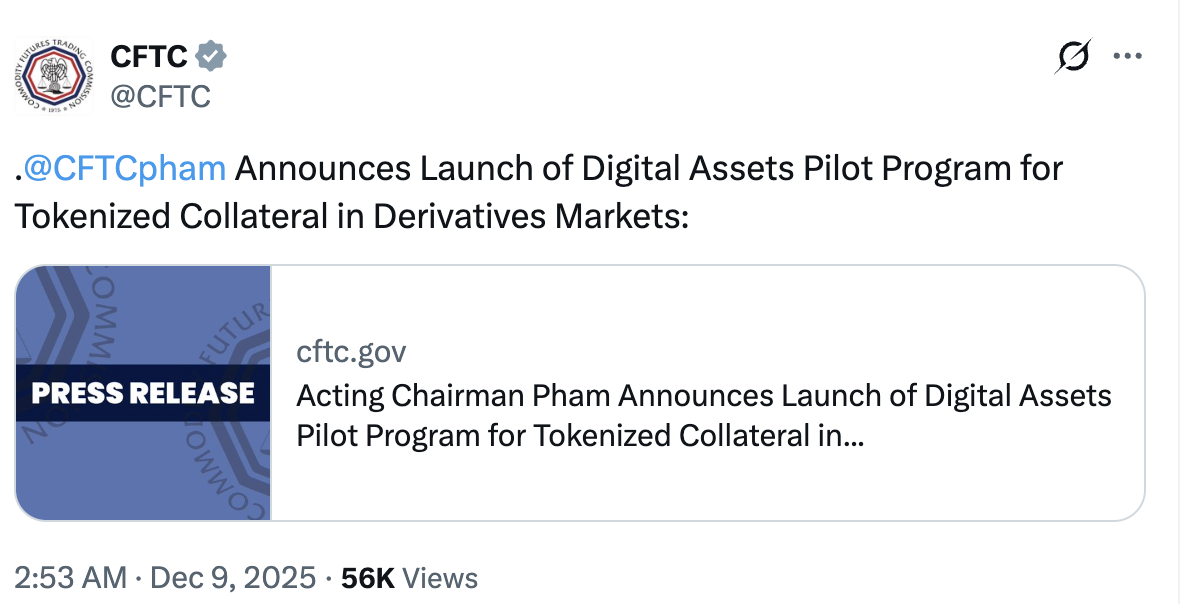
Image Source: CFTC
What the Pilot Program Entails
The program allows select clearing members and derivatives clearing organizations (DCOs) to experiment with tokenized versions of traditional collateral on permissioned blockchains. Participants can post and manage margin requirements using smart contracts, with atomic settlement slashing settlement times from T+1 to near-instant. The CFTC's lab-style setup includes strict guardrails: initial tests limited to $500 million in notional value, real-time risk monitoring via oracles, and mandatory stress testing against black swan events.
CFTC Chair Rostin Behnam highlighted the program's dual focus during a virtual press briefing: "We're not just theorizing; this is about proving tokenized collateral can enhance liquidity, reduce costs by up to 90%, and mitigate counterparty risks in our $20 trillion derivatives market." Early partners include heavyweights like CME Group, which will pilot tokenized T-bills on its clearinghouse, and blockchain firms such as Circle and Securitize providing the tech backbone with USDC-backed wrappers.
Timing Meets Market Momentum
This launch comes at a pivotal moment. Tokenized RWAs have exploded in 2025, with BlackRock's BUIDL fund alone surpassing $5 billion AUM and total on-chain treasuries hitting $15 billion across Ethereum and Solana. Derivatives markets, handling over 80% of global trades, have been bottlenecked by legacy systems—manual reconciliations, siloed collateral, and haircuts eating into capital efficiency. The pilot taps into post-FTX reforms, building on the CFTC's 2024 digital asset recommendations and aligning with the SEC's own tokenized securities pilots.
Implications
For crypto natives, it's validation: tokenized collateral could onboard institutional giants, boosting demand for stablecoins and Layer 2s like Base and Arbitrum. Expect a surge in hybrid products. But risks loom: smart contract bugs, oracle failures, and regulatory whiplash if pilots flop. Critics worry about centralization, with CFTC oversight potentially stifling permissionless innovation. Still, success here could pave the way for broader CFTC nods to spot crypto ETFs and DeFi clearing. As Behnam put it, "Tokenization isn't the future, it's the present we're stress-testing today."
Future Outlook
The pilot kicks off Q1 2026 with six-month phases, expanding based on data. Shares in blockchain enablers like Chainlink (up 8% pre-market) and Ondo Finance spiked on the news. Crypto Twitter is alight, with #CFTCPilot trending alongside memes of Behnam as a reluctant bull. This is a regulatory green light for the token economy. If it delivers, derivatives markets could look unrecognizably efficient by 2030.


Leave a Comment