Ethereum Foundation Bids Farewell to Holesky Testnet After Fusaka Upgrade
The Ethereum Foundation has officially announced the shutdown of the Holesky testnet. The decision comes just two weeks after finalizing the Fusaka upgrade, and it signals both the end of an era and the start of new testing horizons for the blockchain ecosystem.
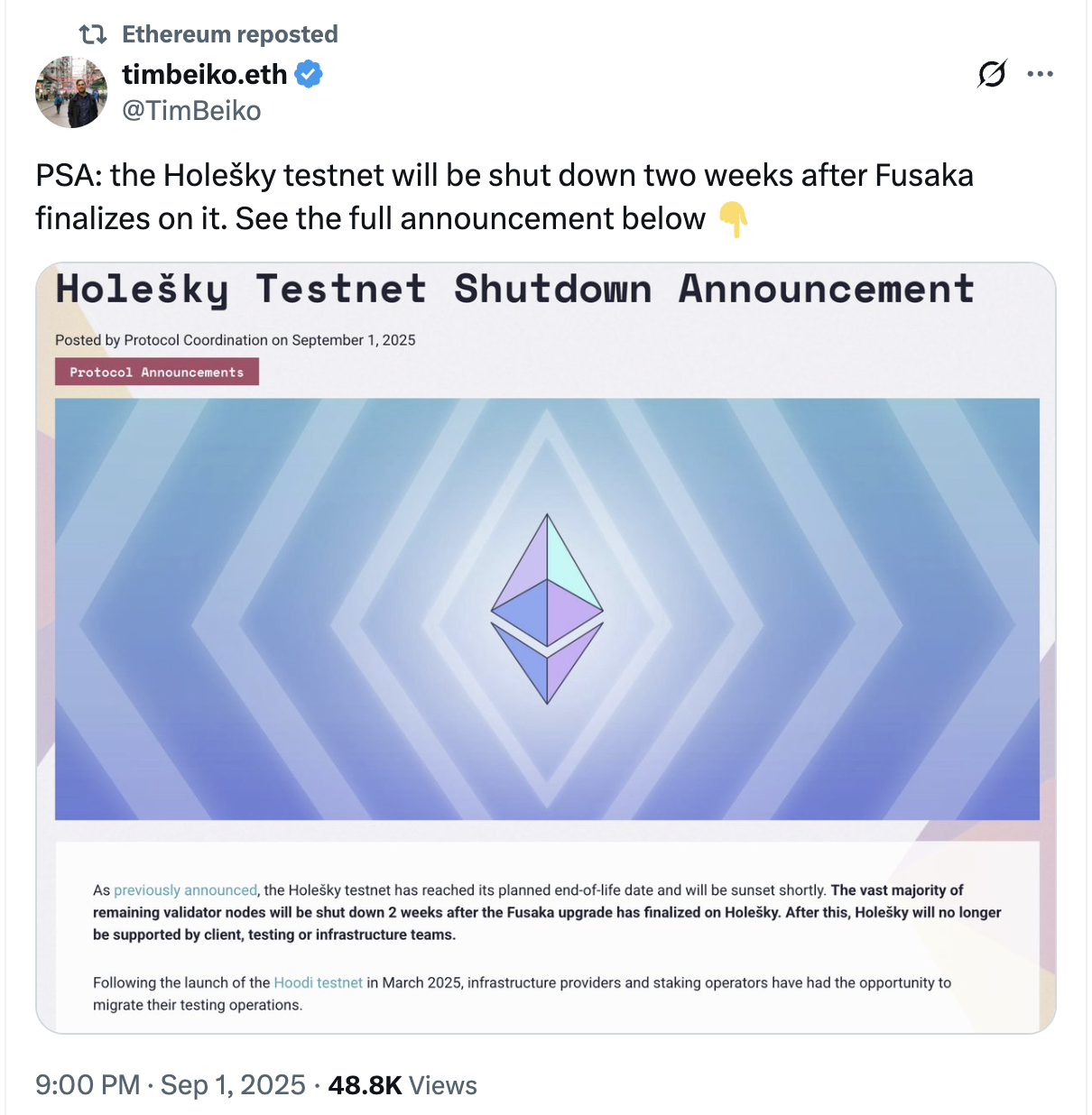
Image Source: Ethereum
Holesky’s Journey
Launched in September 2023, Holesky quickly established itself as Ethereum’s largest and most prominent public testnet. Designed to support robust testing of staking infrastructure and validator operations, Holesky reached remarkable scale, allowing thousands of validators to stress-test protocol upgrades from the Dencun release to the highly anticipated Pectra and now Fusaka. For nearly two years, developers, infrastructure providers, and staking operators relied on Holesky for a reliable, real-world simulation environment.
But as network demands evolved and new upgrades rolled out, Holesky began showing its age. The early 2025 run of the Pectra upgrade exposed a major flaw: a large-scale “inactivity bug” triggered a surge in validators exiting, clogging the exit queue and slowing critical tests. Despite tireless restoration efforts, it became clear to core developers that Holesky could no longer provide the smooth, efficient lifecycle needed for next-generation upgrade testing.
The Hoodi Testnet
Reacting promptly to these challenges, Ethereum’s development teams set to work on Hoodi, a brand-new testnet designed to resolve Holesky’s limitations. Launched in March 2025, Hoodi offers a streamlined validator experience, full compatibility with all current protocol features, and a clean slate for future upgrades. By the time Fusaka was scheduled on Holesky, large parts of the testing community had already begun their migration to Hoodi, urged on by guidance from the Foundation.
Now, following the completion of the Fusaka upgrade, the Holesky validator nodes are being systematically shut down. With infrastructure and staking operations handed over, client and testing teams will cease support, effectively ending all central activities on Holesky over the next fourteen days.
Fusaka’s Impact
The final upgrade Fusaka acted as both the capstone and the swan song of Holesky’s utility. Fusaka brought 11 new Ethereum Improvement Proposals (EIPs) to the table, focused on optimizing Layer-2 scalability, reducing validator bottlenecks, and supporting more efficient transaction processing. The entire Holesky run of Fusaka paved the way for the upgrade’s mainnet launch, scheduled for November 2025, ultimately boosting confidence in Ethereum’s long-term prospects.
What’s Next for Ethereum Testnets?
The closure of Holesky underscores the blockchain’s continuous push for improvement. Staking operators, developers, and infrastructure providers are now advised to switch to Hoodi for future testing. Sepolia and Ephemery, the other active testnets, remain available for smart contract and DApp experimentation. Legacy testnets like Kiln, Ropsten, and Goerli have previously been phased out, Holesky’s retirement is part of the norm in Ethereum’s progressive development culture.
A New Chapter Begins
For those who relied on Holesky, its end is tinged with nostalgia and achievement. Yet the move to Hoodi and the innovations accompanying Fusaka and upcoming upgrades like Glamsterdam underscore Ethereum’s ongoing evolution. The path ahead promises not only greater scalability and decentralization but also more resilient, advanced, and future-ready testing infrastructure.


Leave a Comment