Ink Unveils Tydro, a new liquidity Protocol Powered by Aave v3 and the INK Token
Ink, the Ethereum Layer 2 project backed by Kraken, has unveiled Tydro, a new decentralized liquidity protocol that’s set to make big waves in the world of decentralized finance (DeFi). Tydro is a white-label instance of the industry-leading Aave v3 protocol, tailored to natively support Ink’s own INK token. This marks a pivotal moment both for the Ink ecosystem and for the integration of next-generation DeFi tools on prominent Ethereum scaling solutions.
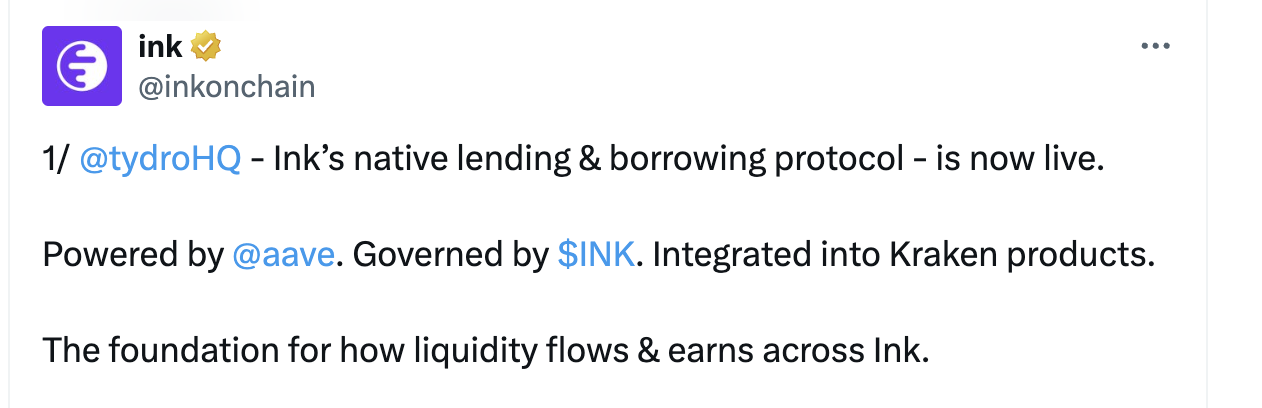
Image Source: Ink
Tydro
The launch of Tydro places Ink squarely in the spotlight as a serious contender among Ethereum’s Layer 2 networks. At its core, Tydro uses the robust and battle-tested infrastructure of Aave v3, the largest lending protocol in decentralized finance with over $75 billion in deposits and more than $30 billion in active loans across the network.
Ink’s approach is distinct: Tydro is engineered exclusively for the Ink environment, offering a decentralized marketplace for lending and borrowing cryptocurrencies while making full use of the native INK token. The Ink Foundation calls Tydro “core infrastructure for DeFi on Ink”, spotlighting its ambition to drive everything from retail borrowing to developer-led innovation in DeFi.
Real Utility for the INK Token
Unlike many tokens that pivot between governance and speculative promises, the INK token takes a different route. Within Tydro, INK is front and center as both a liquidity incentive and a reward for platform users. When lending or borrowing on Tydro, users not only earn yield but also accumulate INK rewards, as well as points toward future airdrops. Since its initial introduction, the INK token’s focus has shifted away from governance, with its main function being to encourage deeper participation across the Ink ecosystem. Since news of the protocol’s launch, total value locked (TVL) on Ink has surged, approaching $140 million.
Supported Assets
At launch, Tydro supports blue-chip digital assets including wrapped Ethereum (wETH), Kraken’s kBTC, and core stablecoins such as USDG, USDT0, and GHO. Looking ahead, the lineup will expand to yield-bearing tokens and new liquid staking assets, all aimed at bolstering liquidity, reward opportunities, and financial depth within the network.
One of the most noteworthy steps is Kraken’s planned integration of Tydro into its main exchange platform. This will enable Kraken’s global user base to access decentralized lending and borrowing opportunities directly, bypassing much of the technical friction that can deter mainstream adoption. Kraken is also evaluating ways to include INK and related airdrop rewards in its own product suite, deepening the ties between centralized and decentralized finance.
Shifting the DeFi Landscape
With Tydro’s debut, Ink positions itself on the cutting edge of Layer 2 DeFi innovation. By rooting its new protocol in Aave’s trusted ecosystem and offering unique incentives via the INK token, the project sets a new standard for Layer 2-native DeFi infrastructure. As competition heats up in the Ethereum scaling space, Ink’s commitment to seamless, secure, and rewarding financial tools could shape the next wave of crypto participation.


Leave a Comment