Ripple and other Crypto Giants Edge Closer to U.S. Banking Status
Ripple, BitGo and three other digital asset heavyweights have secured conditional approval from U.S. banking regulators to operate as national trust banks. The move signals that Washington is finally ready to bring leading crypto firms deeper into the regulated banking framework, rather than leaving them at the fringes of traditional finance.
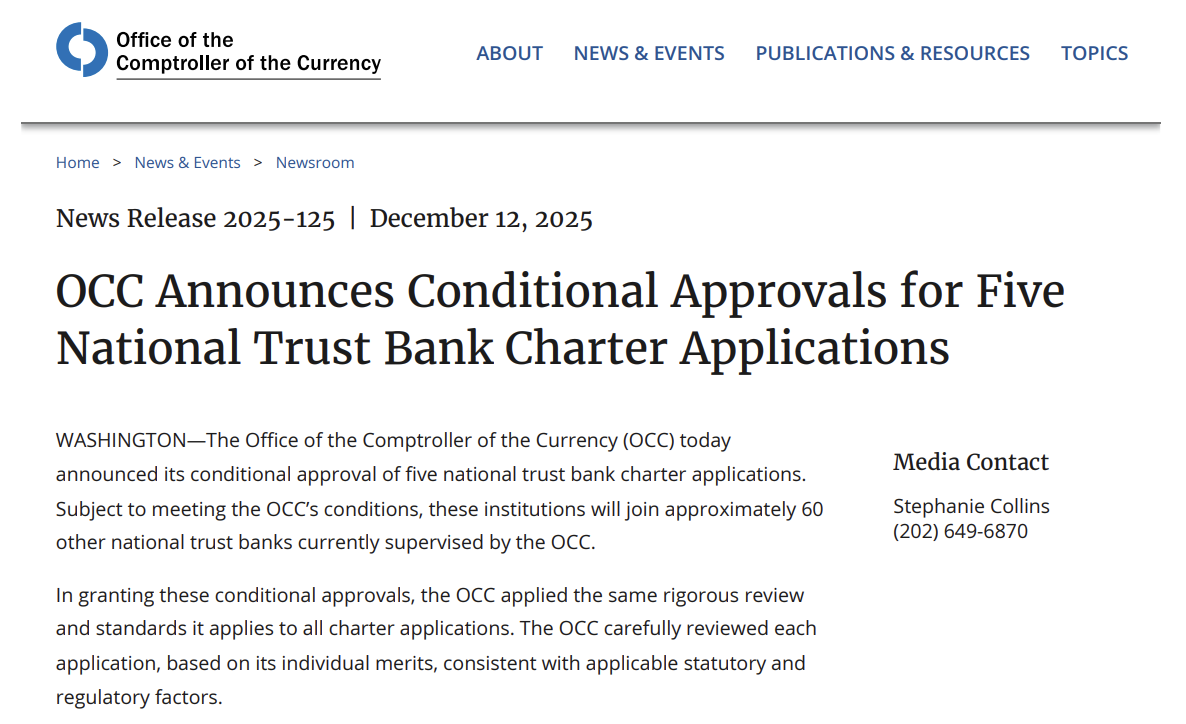
Image Source: OCC
What Exactly Has Been Approved?
The OCC’s decision covers five firms: stablecoin issuer Circle, blockchain payments company Ripple, digital asset custodian BitGo, Fidelity Digital Assets and Paxos. For Circle and Ripple, the regulator has conditionally approved brand-new national trust bank charters, while BitGo, Fidelity and Paxos have been cleared to begin converting their existing state trust companies into federally chartered national trust banks. These entities are not yet “full banks” in the traditional sense. Under the terms of the conditional approvals, they are limited-purpose national trust banks focused on custody, settlement and related services, and they are not allowed to take retail deposits or offer FDIC‑insured accounts. The OCC has attached stringent conditions around capital, compliance, risk management and governance that must be met before any of the charters become fully effective.
Why It Matters?
For Ripple, the green light is the culmination of a strategy that began when the firm publicly confirmed it was seeking a U.S. banking license earlier in 2025. The new Ripple National Trust Bank would sit at the heart of its push to link its RLUSD stablecoin and XRP-powered payment rails directly into the U.S. banking framework, under both federal and New York state oversight. BitGo, meanwhile, gains a pathway to upgrade its status as a major institutional custodian, with a national charter that can help it serve clients across state lines under a single, recognized federal regime. For the broader crypto market, the OCC’s move is being read as a turning point similar in weight to the approval of spot bitcoin ETFs for securities markets: a clear, institutional stamp of legitimacy on parts of the industry that handle stablecoins, institutional custody and tokenization.
A Shift in Regulatory Stand
The approvals build on legal groundwork laid as far back as 2021, when the OCC clarified that it could charter national trust banks whose activities center on custody and fiduciary services, including the safekeeping and settlement of digital assets. Under the new Trump administration, the White House has signaled a friendlier approach to crypto, framing this wave of charters as a way to bring systemic activities onshore and under direct supervision rather than allowing them to grow in regulatory gray zones. Still, the OCC has retained the right to alter, suspend or revoke its conditional approvals if any of the firms fall short of the requirements during the build-out phase.
What Happens Next?
From here, each firm enters an intensive period of supervisory engagement, during which they must prove that their compliance infrastructures, capital buffers and risk controls meet the OCC’s standards. Only once the regulator is satisfied will the charters be fully activated, potentially opening the door to deeper integration with Federal Reserve payment rails and larger institutional clients.


Leave a Comment