Sui Introduces Tessera for Private B2B Stablecoin Settlements
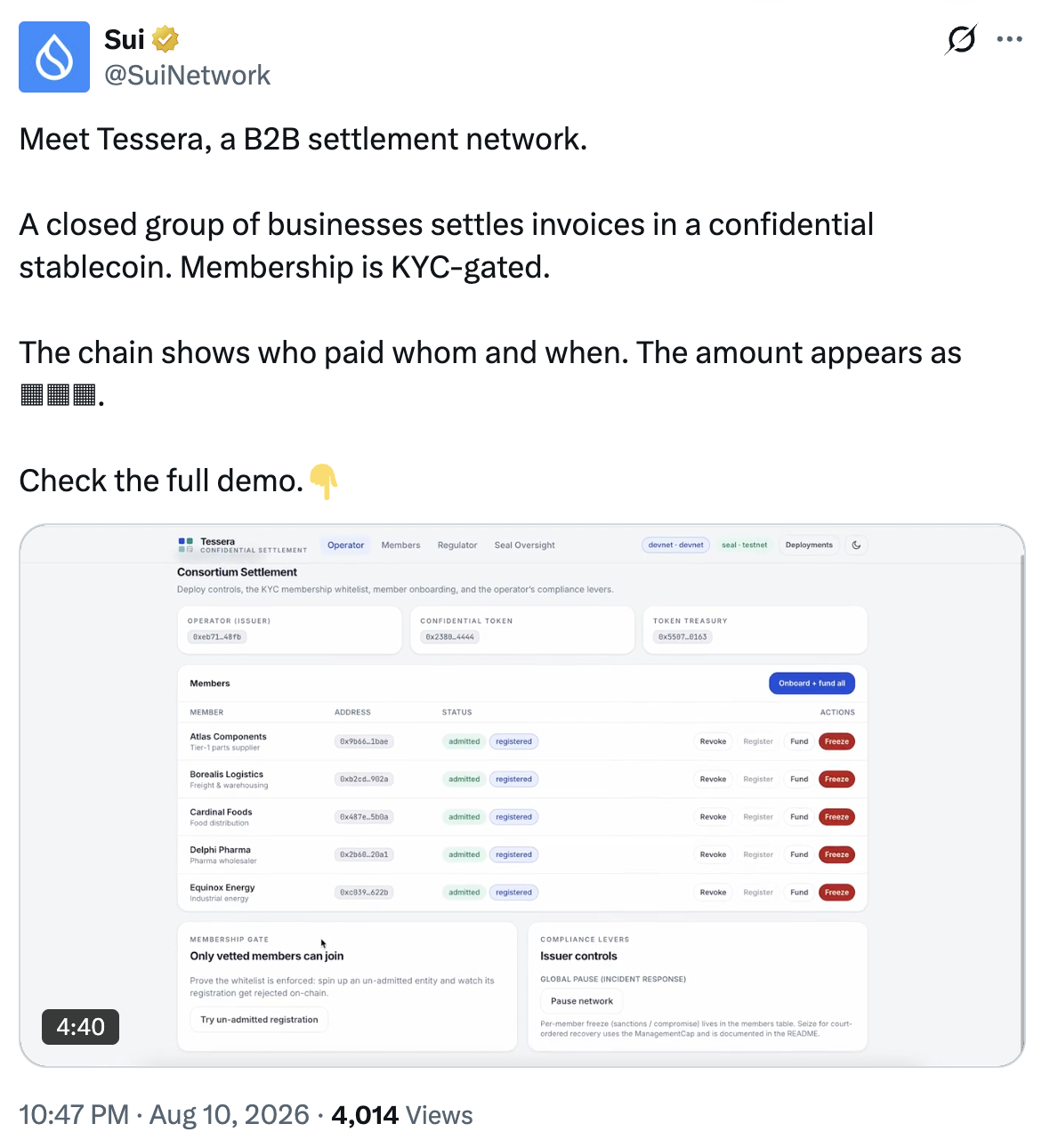
Sui has introduced Tessera, a private B2B settlement network designed to help companies settle invoices with stablecoins without publicly exposing payment amounts. Developed by Mysten Labs, the prototype combines Sui’s Confidential Transfers technology with Seal multi-party computation (MPC) to balance commercial privacy, regulatory oversight, and blockchain-based settlement.
The announcement comes as financial institutions increasingly explore stablecoins for faster cross-border payments and treasury operations. However, public blockchains often reveal transaction values, allowing competitors and other market participants to monitor pricing, payment volumes, and corporate cash movements. Sui says this lack of privacy has been a major obstacle to wider blockchain adoption in business payments.
How Tessera Protects Corporate Payments
Tessera is designed as a closed settlement network for KYC-approved businesses. Participating companies can use a confidential stablecoin to settle invoices while the blockchain continues to record the sender, recipient, and transaction time. The key difference is that the payment amount remains encrypted for outside observers. A supplier and its customer can view the relevant transaction details, but an unrelated company monitoring the network cannot see the value of the payment.
This structure could help businesses protect sensitive information, including supplier pricing, trade volumes, payroll data, treasury movements, and commercial agreements. Tessera supports both one-time payments and recurring payment channels, making it potentially useful for regular invoices and ongoing business relationships.
Compliance Remains Central
Tessera is not designed as an anonymous payment network. Access is restricted to verified businesses, while authorized third parties can receive limited access to transaction information when necessary. Seal MPC enables permission-based access to encrypted payment data. For example, a regulator may be allowed to review activity across the network, while a tax authority could receive access only to records connected to a specific company. An arbitrator might be given temporary access to a disputed payment while a commercial disagreement is being resolved.
According to the available details, these permissions can be scoped, time-limited, and revoked. Authorized viewers can inspect transaction data, but they do not gain the ability to move the underlying funds. This approach is intended to give enterprises privacy without removing auditability and regulatory controls.
Sui’s Growing Payments Strategy
Tessera forms part of Sui’s broader push into institutional payments and stablecoin infrastructure. Sui’s payments platform highlights subsecond settlement, gasless stablecoin transfers, programmable payment logic, and high-throughput transaction processing. The network currently advertises approximately 300-millisecond finality and capacity of up to 20,000 transactions per second, with a reported 297,000 consensus-based transactions per second under benchmark conditions. Sui’s website also reports $36 billion in stablecoin utilization for April 2026.
The network positions its infrastructure as a way for companies to move stablecoins without managing a separate gas token, while connecting settled capital to wallets, fiat on-ramps, and decentralized finance applications. These features could make Sui attractive for companies seeking faster settlement than traditional correspondent banking systems. Nevertheless, payment speed alone is not enough for institutional adoption. Businesses also require clear legal frameworks, reliable stablecoin liquidity, strong custody systems, and integration with existing accounting and enterprise resource planning software.
Prototype Status and Next Steps
Tessera remains a prototype, rather than a fully launched commercial network. Sui has not publicly disclosed a launch date, participating companies, stablecoin issuer, or initial deployment jurisdiction. SUI was trading at approximately $0.69 following the announcement, within a reported 24-hour range of roughly $0.684 to $0.704. The token showed no clear price reaction directly linked to the Tessera announcement.
The project’s next major test will be whether Sui can move Tessera from a controlled demonstration to a production-ready solution for regulated companies. If it succeeds, confidential B2B stablecoin settlement could become an important use case for Sui and strengthen its position in the growing institutional payments market.


Leave a Comment