The Fusaka Upgrade has Gone Live on Ethereum
Ethereum’s highly anticipated Fusaka upgrade activated smoothly on the mainnet yesterday, Dec 3, 2025, at slot 13,164,544(21:49:11 UTC), marking the blockchain's second big code change this year. This hard fork blends the Osaka execution layer tweaks with the Fulu consensus updates, pushing Ethereum closer to its vision of massive scalability without sacrificing security.
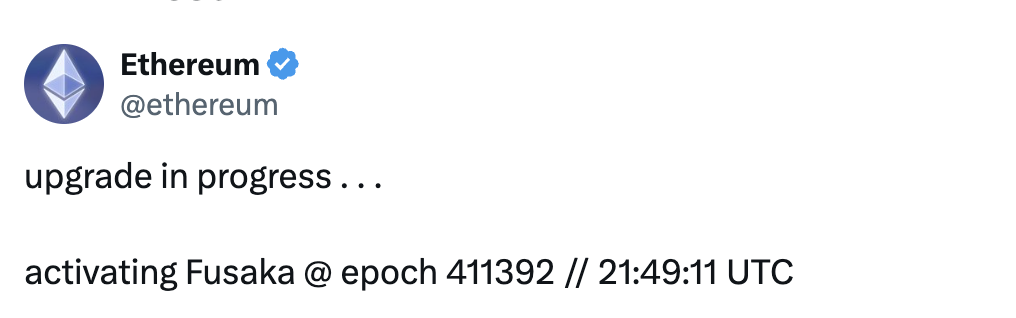
Image Source: Ethereum
What Fusaka Delivers
At the heart of Fusaka lies PeerDAS (Peer-to-Peer Data Availability Sampling), a breakthrough that lets nodes sample just portions of blob data instead of downloading everything. This slashes bandwidth and storage costs for validators while boosting blob throughput by up to eightfold—building directly on Dencun's proto-danksharding. Ethereum co-founder Vitalik Buterin called it a "literal sharding" moment, fulfilling a 2015 dream now realized through data sharding. The upgrade packs 12 Ethereum Improvement Proposals (EIPs), including blob-parameter-only forks for quick capacity tweaks sans full hard forks, stabilized blob base fees, and a 16,777 gas cap per transaction to fend off DoS attacks. Node operators see lighter loads, while Layer-2 rollups like Optimism's Superchain gear up for 100,000+ TPS.
Smooth Rollout After Rigorous Tests
Fusaka aced three testnets: Holesky, Sepolia, and the final Hoodi run in late October, with developers locking in the December 3 mainnet date. Validators reported zero hiccups during activation, underscoring Ethereum's maturing upgrade process post-Merge and Pectra. Bitwise analysts note this cements Ethereum's role as the go-to settlement layer for on-chain finance, handling exploding L2 batches ($47B economy).
Market Buzz and Price Action
ETH holders felt the vibe immediately. Price swelled post-launch, echoing Pectra's rally, as traders bet on cheaper L2 fees and broader adoption. Everyday users win with smoother, low-cost transactions on rollups; devs get efficient data handling; institutions eye passkey integrations for secure access. No smart contracts broke—business as usual, just better.
Why It Matters for Ethereum's Future
Fusaka isn't flashy UX candy; it's infrastructure rocket fuel. L2s now post more data affordably, easing congestion and unlocking DeFi, gaming, and AI apps at scale. It paves the way for Glamsterdam next, eyeing proposer-builder separation. Critics say it's Ethereum's "boldest scalability bet," targeting $410B market cap growth amid competition.


Leave a Comment